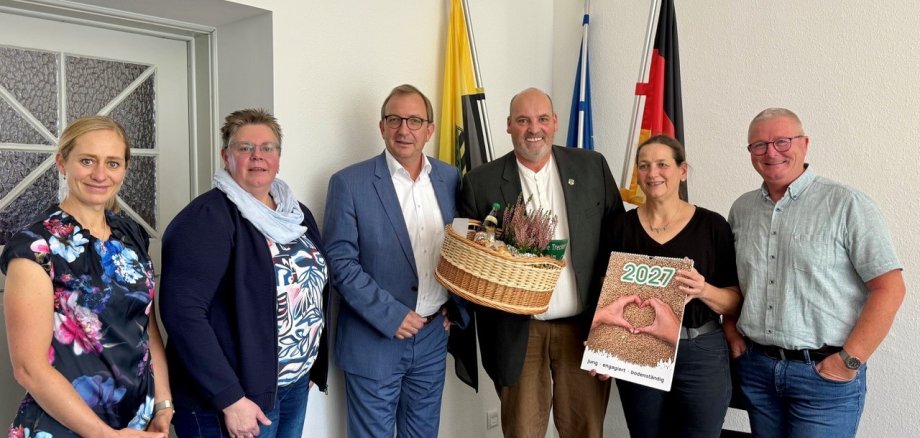
Bernburg. A spring that looked promising from the perspective of agricultural businesses was followed by another heatwave in the summer that lasted for weeks, leaving a profound impact on the farmland in the Salzland district: “Poor yields coupled with a sharp rise in operating costs – after many years of difficult conditions, our farmers’ nerves are frayed,” said Matthias Saudhof, chairman of the Salzland District Farmers’ Association, summing up the mood at the annual presentation of the harvest basket to District Administrator Markus Bauer. “Many farms are now at breaking point,” added managing director Katharina Elwert.
The harvest basket is put together by the Salzland and Nordharz farmers’ associations. The handover in autumn is seen by both the farmers and the Salzland district as a sign of trust-based cooperation – even in more difficult times. “We can only overcome these challenges together. That is why regular dialogue is important,” said District Administrator Markus Bauer. He thanked the association representatives for their candid remarks. He emphasised: “Wherever we can provide support, we naturally stand by our farmers. After all, they are an indispensable part of our predominantly rural region.”
Almost three-quarters of the area is used for agriculture. Thanks to its top-quality soil, the region has traditionally been characterised by arable farming. Due to the climate, specialised crops such as medicinal and aromatic plants and onions also play a significant role. The Salzlandkreis stands by local farmers as a reliable partner, offering specialist services in the areas of climate, environment and nature conservation; health and consumer protection; veterinary affairs; and district development and tourism. The close relationship between the district and the farming community is also evident from the jointly planned presence of the Salzlandkreis and farmers’ associations at Green Week in Berlin early next year. Preparations for this are currently under way.
In this context, the District Administrator pointed out that, on the basis of so-called dynamic water law permits, the Salzlandkreis had once again not had to impose a blanket ban on water abstraction this year, and highlighted the district administration’s commitment to climate protection and climate adaptation. The content of the relevant plans is also regularly coordinated with the farmers’ associations. Other topics discussed included new animal diseases and pests, such as the reed glasswing cicada, which still cannot be effectively controlled.