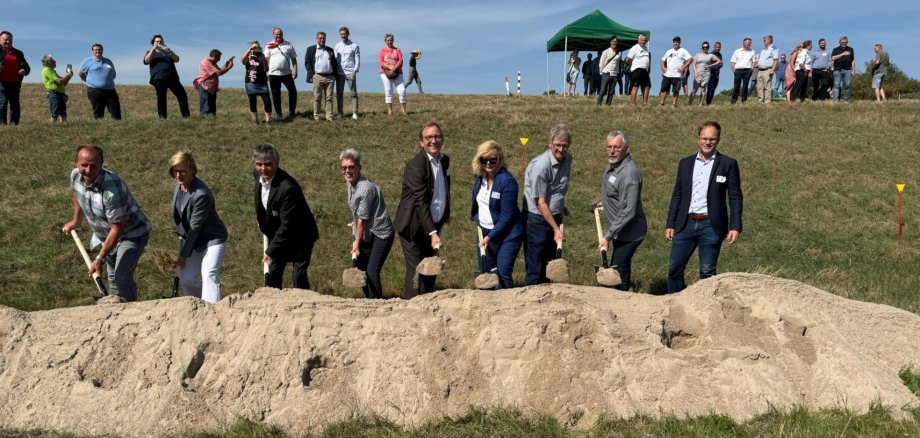
Groß Rosenburg. A vision becomes reality! With a symbolic ground-breaking ceremony for the pedestrian and cycle bridge near Groß Rosenburg, District Administrator Markus Bauer, together with all the partners involved in the project, officially launched the construction phase on Thursday for one of the largest infrastructure projects in the field of mobility ever undertaken in the Salzlandkreis.
Over the next few years, a 276-metre-long bridge spanning the River Saale between Werkleitz and Groß Rosenburg is to be built at a cost of around 7.4 million euros; this will not only improve the connection between the two towns but also provide a significant boost to sustainable mobility. At the ground-breaking ceremony, District Administrator Markus Bauer thanked everyone who had made the project possible over the past few years: “Once again, we can see just how successful we can be as a region when we set ourselves common goals and pursue them consistently.”
Dr Ingrid Hanhoff from the Federal Ministry for the Environment, Nature Conservation, Climate Protection and Nuclear Safety also emphasised this in her welcoming address. “Despite challenging circumstances, the Salzlandkreis spared no effort in submitting its application and ultimately made a convincing case as to why this project deserves federal funding.” Around five million euros are coming from the National Climate Protection Initiative funding programme.
The senior official from the Federal Ministry emphasised that the project serves as a model for the whole of Germany. “The transport sector is a major source of greenhouse gas emissions. Sustainable mobility is therefore hugely important for climate protection.” According to her, the bicycle now plays a major role as a means of transport. For 55 per cent of people in Germany, it is even indispensable.
District Administrator Markus Bauer expressed his conviction that this bridge, built exclusively for pedestrians and cyclists, would have a lasting impact on day-to-day mobility in the region and would also provide a boost to tourism. He compared the project to the Saale Bridge near Gröna in Bernburg, which was built more than 20 years ago and has since been used regularly by thousands of cyclists and pedestrians. “Distances of 50 kilometres or more are no longer a problem these days thanks to electric bikes. In the morning at the Ringheiligtum, at lunchtime at Reimanns in Bernburg, and in the afternoon a visit to the Neo-Rauch Foundation. We are connecting the Salzlandkreis bit by bit in a sustainable way with the help of new cycle paths. This benefits the entire region as an attractive place to live, do business and pursue science.”
The planning work, commissioned by the relevant department for district development, tourism and school transport and carried out by the planning consortium comprising Ingenieurgemeinschaft Gnade GmbH and IGS Ingenieure GmbH & Co. KG, has been completed. The former managing director, Helmut Gnade, commented that cooperation with the district administration had been truly excellent throughout. He said: “The pedestrian and cycle bridge will be a landmark for the entire region: a modern and sustainable Saxony-Anhalt.” Archaeological surveys will take place over the coming weeks, after which the excavators will move in. If everything goes according to plan, the bridge can be opened in 2028.
The construction schedule is strictly timed, said Dr Martin Arlt (Dr.-Ing.) of Arlt Bauunternehmen GmbH, which had been awarded the contract for the bridge construction jointly with ZSB Zwickauer Sonderstahlbau GmbH. He explained that around 550 tonnes of structural steel and around 250 tonnes of reinforced concrete are planned for the structure. The individual components are being manufactured at the plant in Calbe. “This is regional economic development at its best,” said the district administrator.
In his speech, Markus Bauer also thanked the district councillors and chief administrative officers throughout the Elbe-Saale-Winkel region for their support. “Together, we are not making the region richer, but more valuable.” Barby’s mayor, Dr Jörn Weinert, responded on their behalf: “We are very, very grateful that the bridge is being built. It will make it easier for many cyclists to cross the Saale on a regular basis, especially when the ferry cannot operate.”
In addition to the funding bodies and contractors mentioned, the State Agency for Flood Protection and Water Management in Saxony-Anhalt, the Magdeburg Waterways and Shipping Authority and the State Office for Archaeology and the Preservation of Historical Monuments are also involved in the project. Representatives from these organisations were also present at the ceremony.