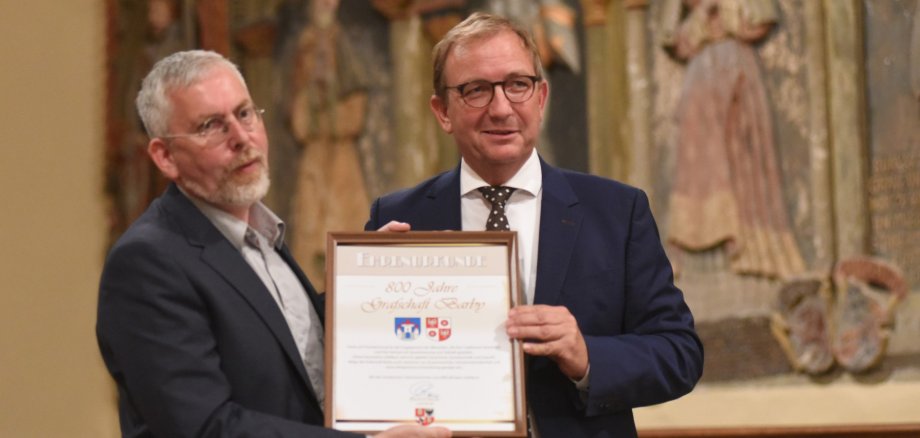
Barby. “A sense of home does not arise of its own accord. It arises where people take action.” That was the message from District Administrator Markus Bauer at the launch of the “800 Years of the County of Barby” festival week, which opened last Friday evening with a prayer service at St John’s Church in Barby.
St John’s Church is regarded as the burial church of the Barby family of counts, whose colourfully painted epitaphs can still be seen on the walls today. The anniversary marks the first documented mention of the church in 1226. However, the celebrations are not intended to honour the counts, but to celebrate the joint efforts of all eleven districts of the unified parish, most of which share common historical roots.
This was precisely the point the District Administrator made in his welcoming address. “Home is not something to be taken for granted. Home is what we make of our region,” said Markus Bauer. It is the clubs and the many volunteers who have ensured that 800 years of history have not merely become a date on the calendar, but a vibrant community.
The mayor and organiser of the anniversary celebrations, Dr Jörn Weinert, called for unity within the unified municipality in this context. “We must stick together, in good times and bad.” The District Administrator presented the mayor with the Salzlandkreis certificate of honour on behalf of the many dedicated individuals in the local districts.
The District Administrator also highlighted the town’s unique location. Barby lies at the confluence of the Saale and the Elbe rivers and has always been a crossroads where paths meet. This location has shaped the town over the centuries and also symbolises the role of the entire Salzlandkreis district. “The district acts as the link between Halle and Magdeburg, right in the middle between two major cities. The whole region benefits from this,” said Markus Bauer.
The keynote speech highlighted just how closely history and the present are intertwined in Barby. The historian Prof. Konrad Breitenborn from Wernigerode traced the life and work of the Barby farmer and politician Adolph von Dietze, who in 1848 financed the construction of local district roads with a thousand talers, thereby creating numerous jobs.
Among the guests were Gernot and Helga von Dietze, who are descendants of the family.