
- Exhibition: ‘Namibia – Germany. Current aspects of a special relationship’
- Duration: 9 September to 16 October 2026
- Venue: Foyer, Sparkassenschiff, Lehrter Straße 15, 39418 Staßfurt
- Opening hours: Mondays 8.00 am to 4.00 pm, Tuesdays and Thursdays 8.00 am to 6.00 pm, Wednesdays and Fridays 8.00 am to 3.00 pm
- Free admission
Bernburg/Staßfurt. Between 1985 and 1990, around 400 Namibian children and young people attended the ‘School of Friendship’ in Staßfurt. They came to the GDR from refugee camps during their country’s struggle for independence, grew up there and attended school in Löderburg and Staßfurt.
Many of the former pupils now live in the Ohangwena region in northern Namibia. However, their ties to the region have never been severed. The Salzlandkreis and the Ohangwena region in Namibia wish to build on this together – through a partnership. The initiative came from Namibia. Kadiva Hamutumwa, Governor of the Ohangwena region, approached the Salzlandkreis in autumn 2025.
An exhibition running from 9 September to 16 October in the foyer of the Sparkassenschiff in Staßfurt will explore a possible shared future. The exhibition is entitled “Namibia – Germany. Current Aspects of a Special Relationship’. It will be opened by District Administrator Markus Bauer together with representatives from the Namibian Consulate. The project is supported by the Salzlandsparkasse, which is making its foyer in Staßfurt available for the occasion.
District Administrator Markus Bauer says, with regard to the Salzlandkreis 2030 strategy for the future: “Our district stands for business, housing and science. In all three areas, cooperation with Namibia can make a difference.” He explains: “Our businesses are looking for skilled workers, our agricultural sector has expertise that is needed elsewhere, and our schools and clubs thrive on cross-border contact.”
Cooperation is conceivable in the areas of vocational training and dual training programmes, in youth sports development and in agriculture. The Salzlandkreis is a major agricultural centre; in Ohangwena, the focus is, amongst other things, on improving methods for accessing water.
The story of Naita Hishoono shows just how recent this past still is. She arrived in the GDR on 18 December 1979 as a three-year-old, first in Bellin in Mecklenburg, and later in Staßfurt. Today she lives in Namibia again, where she heads the Namibia Institute for Democracy. Back then, the group at the boarding school became her new family. Various photographs show that, for many, Staßfurt was not just a stopover, but a home. Many people who now live in Namibia – and who later found themselves in Europe – learnt their way around and went to school in Staßfurt.
This is precisely where the Salzlandkreis comes in. Looking back should lead to a step forward. “In Staßfurt, we have a past that has shaped us for a long time. This memory is an asset we can build on,” says District Administrator Markus Bauer. “We don’t just want to commemorate this period; we want to breathe new life into it. That’s why we’re seeking dialogue with the people of Ohangwena. Where people know one another, trust is built. And where there is trust, both sides ultimately benefit.”
The exhibition tells the story of the Namibian children in Staßfurt and that of German-Namibian relations. It invites the people of Salzland to learn about this connection and to help foster it. For Naita Hishoono, her return in September is both a look back at her own childhood and a sign that this story continues. She has now returned to Staßfurt with her daughter. Ahead of her visit, she spoke to Tom Gräbe from the Salzland district about her childhood – about snow, which she mistook for sugar; about an ice-cream parlour in Staßfurt; about Lake Löderburg; and about how those formative years in Staßfurt shaped her.
Ms Hishoono, you lived in the GDR for more than ten years, most of that time in Staßfurt. When you think of that town today – what is the first thing that springs to mind?
To my second home. When I arrived in the GDR in 1979, I first lived in Bellin, a village in Mecklenburg. But Staßfurt – that’s where I grew up.
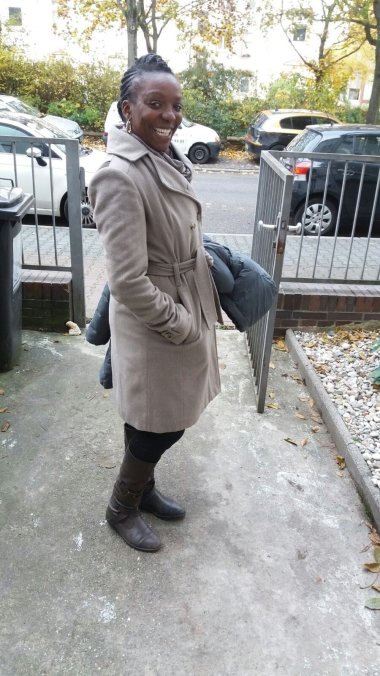
You were just three years old when you arrived in Germany. How on earth did such a young child from Namibia end up in Staßfurt?
We were no longer safe in our neighbouring countries. I arrived in the GDR on 18 December 1979. When the home in Bellin could no longer accommodate us, they looked for a new place and found the boarding school in Staßfurt. Young Mozambicans had previously lived and studied there. When they returned home, space became available for us. That is how I came to Staßfurt in 1986/87.
You arrived in the middle of winter – what comes to mind when you think back on those first few weeks?
It was just before Christmas. The first impressions I remember were those Christmassy smells: the smell of baking biscuits. The snow was also a completely new experience. We thought snow was sugar.
We learnt German quickly. At first, there were just eleven or twelve of us children in a group. That group was a bit like a family. We had three German nursery teachers who worked with us in shifts, and a Namibian nursery teacher to make sure we didn’t forget our own language.
They lived at the boarding school and went to school in the neighbouring village of Löderburg. What was a typical day like back then?
When we were at school, we used to walk to school in Löderburg, or take the bus or cycle there. We did a lot of sport and played music. Our days were very strictly organised. During the holidays, we went to summer camp. We travelled all over the GDR and visited museums. But always as a group. The lovely thing was that during the holidays you got to know other children and made new friends. It was a change of pace.
Despite all the organisation – there were apparently a few moments of freedom too. You once mentioned a late-night shop that used to be near the boarding school back then.
As you get older, you get a bit more pocket money. We didn’t always want to eat in the canteen; we wanted to buy ourselves something now and then. And because we didn’t always manage to get to the canteen on time, there was the ‘Spezi’ – a shop where you could shop late into the evening. It was near the boarding school. We liked going there because it gave us a bit of freedom: going out on our own, buying something for ourselves. Getting out of the boarding school with a friend – that was something special.
And there was also an ice-cream parlour. It seems to have stayed in your memory to this day.
The ice-cream sellers were always very friendly. There were three flavours available at the ice-cream parlour: vanilla, chocolate and fruit. I usually went for vanilla. It was lovely because it felt like a bit of freedom: you could go out on your own and have an ice cream.
In the GDR, work in a factory became part of everyday school life at an early age – practical work and technical drawing were on the timetable. What was your experience of that?
I really enjoyed technical drawing, but I didn’t like the practical work at all. We had to travel to the factory in the cold on those yellow buses. Then you had to put on those blue overalls and file nuts and bits and pieces. I found that awful.
During your visit, you also want to go to Lake Löderburg, just a few kilometres from Staßfurt. It was clearly a special place for you.
Lake Löderburg wasn’t far away – I think only about four kilometres from Staßfurt. You could walk there in an hour or cycle there. It was simply lovely to lie there and go for a swim in the lake. There was a playground and a co-op shop where you could buy a sausage. You didn’t have to go there with the group; you could also go with friends. It was a taste of freedom.
In Namibia, the sun shines almost all year round. At Lake Löderburg, however, the sky was often cloudy – a memory that still haunts you to this day.
In Namibia, we have over 300 days of sunshine. As a child, I always thought: one day I’d like to go for a swim somewhere where there isn’t a single cloud overhead when I come out of the lake. And I told myself: when I grow up, I’ll choose a life where no cloud will ever stop me from drying off.
In 1989 and 1990, the GDR was dissolved. Shortly afterwards, Namibia gained independence. You experienced this period of upheaval as a young woman in Staßfurt. How did that affect you?
I witnessed everything in Staßfurt: how the first East German citizens fled via Hungary and Austria that summer, our last holiday camp, how the GDR changed before our very eyes, how the nursery teachers came and went, and the preparations for our return to Namibia. It opened my eyes to how people influence systems, that systems are made by people, and that even adults can lie. As a child, it was very strange that the system I’d grown up in was suddenly regarded as the wrong one.
Above all, though, I’ve learnt this: not everything you read and hear is the truth. You have to seek out your own truth; you need to consult different sources. If you only trust one source, that’s just part of the truth. There are so many different ways of looking at things. I learnt that very early on.
Now you’re returning to Staßfurt with your daughter, who has only ever visited Germany as a baby. What would you like to show her there?
She was only in Germany as a baby, so she doesn’t know the country. She’s always heard about my history, and now she’s finally seeing a small part of it. She can see: this is where Mummy grew up, that’s where she went to school, this is what the place looked like. That’s important for her to understand why I’ve told her about it, why we speak German, and why that time had such a profound impact on me.