Schadeleben/Bernburg. The Salzlandkreis district is set to receive one million euros to further develop the R1 European Cycle Route in the Seeland area. This news from the State Ministry for Economic Affairs and Tourism was announced just a few days ago. District Administrator Markus Bauer welcomes the additional support from the state and sees it above all as confirmation of the district’s tireless commitment, its strategic approach in collaboration with all partners, and the successes achieved for the region.
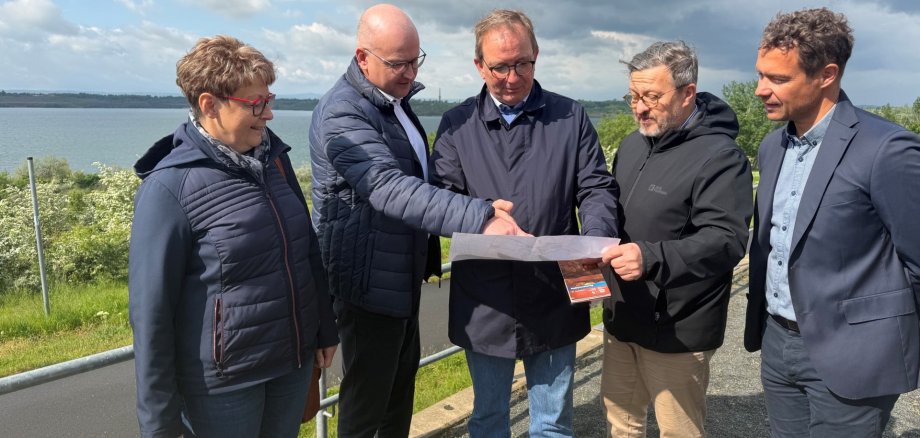
On the lakeside promenade in Schadeleben on Wednesday, he spoke about the new possibilities for the R1 expansion with Mayor Robert Käsebier (2nd from left in the photo), René Walliser (right), Managing Director of Seeland GmbH, and Detlef Gürth (2nd from right), who, as a member of the state parliament, helped to ensure that the additional funds flowed into the tourism region at a political level. Also present was Evelin Wolter from the District and Economic Development and Tourism Department.
"We have two section options in the drawer here and will see which of them we can realise with one million," explains District Administrator Markus Bauer. He also explains why the Salzland district is also benefiting from the state arm in addition to its own share of the special fund: "There are many cycle path projects that are necessary and sensible for us to promote the residential and business location in line with our future strategy, but where we are limited by a lack of funds. In its current selection, the state recognises the interregional importance, whereby this R1 expansion goes very well with our previous activities. We have invested nine million euros in the European cycle route over five years. This improves the quality of the tourism offer for locals and guests."
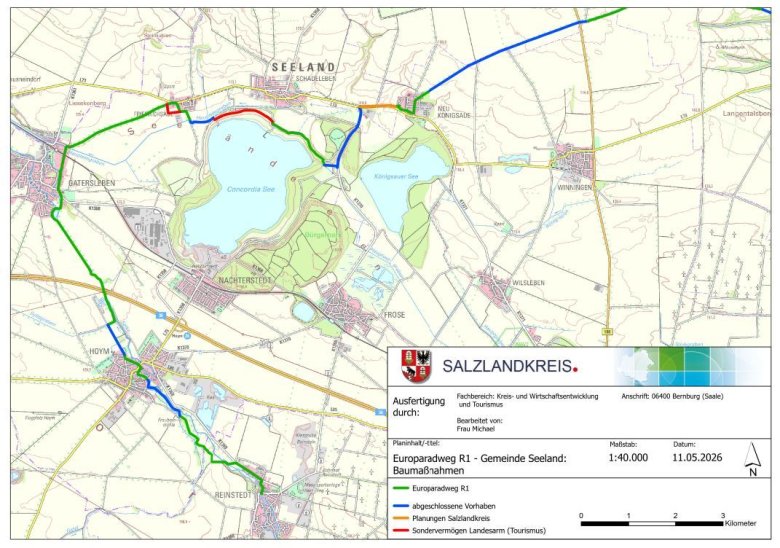
The Salzland district wants to proceed quickly with the realisation and initially conclude an agreement with the town of Seeland, which will later take over the new section of the path. The preliminary planning must show whether the 500 metre section of Neuer Weg Friedrichsaue can be implemented or whether the 1.1 kilometre lake promenade from the completed Friedrichsaue extension section to the restaurant can be completed. If everything goes according to plan, the extension should be completed in 2028.
The town of Seeland is not expected to make any contribution of its own. Mayor Robert Käsebier, who wants to develop the guest region with Seeland GmbH, is particularly pleased about this. Lake Concordia, harbour facilities, an adventure playground, cycle paths and overnight accommodation are increasingly making people want to visit the local region, especially as e-bikes are extending the range. "I am of course very grateful to the district and the state if we are connected to the national cycle network in such a way that longer stays become attractive."
Detlef Gürth is also in favour of efficient investment in cycle paths. In recent years, the state has invested more money than ever before in the history of Saxony-Anhalt. This is also the right thing to do because there is a need and ABM cycle paths from the 1990s are being upgraded to today's standards.
The million for the new measure, which is reserved for the Salzland district at the investment bank, comes from the federal government's special fund for infrastructure. Saxony-Anhalt wants to use its 40 per cent share, the so-called state arm, to finance central, state-significant projects, in addition to other funding channels. In the area of tourism, the R1 European cycle route is a particular focus.
The R1 - which is both D-network route 3 and the German Unity Cycle Route - runs for 75 kilometres through the Salzland district. In recent years, the district and local authorities have already upgraded many sections with varying levels of funding; the Salzland district alone has spent 9.2 million euros on 16 kilometres via its PMO project from the assets of political parties and mass organisations of the GDR.
The town of Bernburg (Saale) realised a new route and an extension between Baalberge and Kleinwirschleben. There is also great interest here in extending the R1 sections in the Leau-Preußlitz and Biendorf areas as part of a joint project.
The expansion of the Staßfurt-Hohenerxleben route has already been decided as a measure to settle the district contribution disputes. As the project organiser, the Salzland district is currently preparing the planning and will hand over the completed cycle path to the town of Staßfurt. If further funds are made available from the state's special funds in the coming years, these will primarily be invested in the replacement of the Gänsefurth flood bridge.
Planning is also underway for a roadside cycle path from Neu Königsaue to Schadeleben. The district is cooperating with the state road construction authority and the towns of Aschersleben and Seeland. The town of Seeland itself is planning to extend the R1 from Fraubornmühle Hoym in the direction of Reinstedt to the Falkenstein/Harz district border.
Saxony-Anhalt is providing local authorities with a total of 7 million euros from the state's 2026 special fund to expand tourism infrastructure, including the construction of tourist trails. As the project organiser, the Salzland district will even receive 1.5 million euros of this, as there is another project to enhance the UNESCO World Heritage Site of Saxony-Anhalt at the Pretzien weir. If you add a third project in the district town, half of these funds will go to the Salzland district.