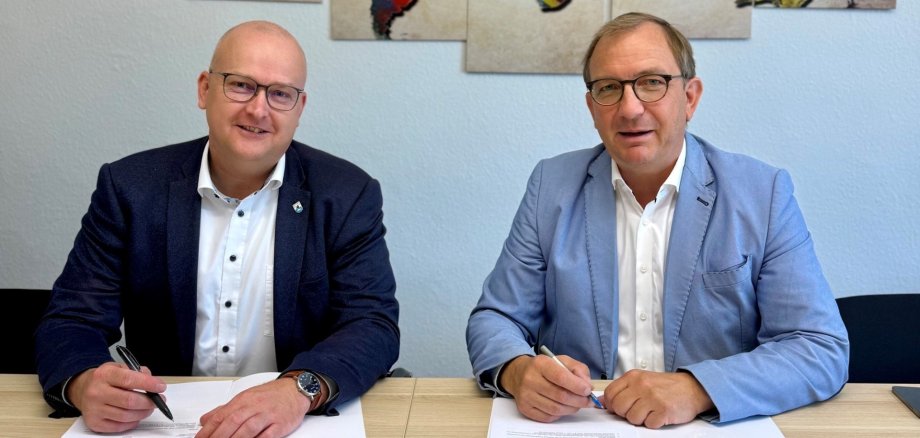
Bernburg/Seeland. The Seeland Town Council had recently unanimously approved the district authority’s proposals for the further expansion of the R1 European Cycle Route; now District Administrator Markus Bauer and Seeland Mayor Robert Käsebier have signed the relevant agreement: On this basis, the Salzland district is continuing to expand the R1 European Cycle Route in the Seeland tourism region – in the Friedrichsaue and Schadeleben areas. The district administration is reconciling the central guidelines with local ideas. One million euros has been made available for the project, with additional funding for the construction of tourist routes drawn from the Saxony-Anhalt branch of the Special Infrastructure Fund.
“This ongoing expansion of the R1 cycle route is a fine example of the success we can achieve within the local authority family when we work together,” explained District Administrator Markus Bauer at the signing of the agreement. “We are joining forces and working together to improve the quality of tourism provision for locals and visitors alike.” A total of nine million euros has been invested in cycling infrastructure in the Salzlandkreis over the past five years as part of the ‘Salzlandkreis 2030’ future strategy. In this context, the District Administrator expressly thanked the state government for its financial support, as local authority funds are not sufficient to cover all plans for the region’s development.
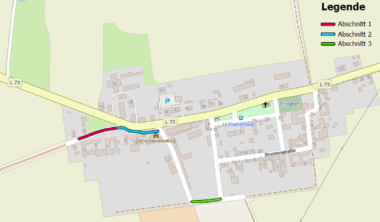
Since the state’s funding commitment became binding in May and the Salzlandkreis had put forward proposals as to which sections could be funded with this money, the local stakeholders held several further rounds of discussions over the summer to coordinate their plans in greater detail. For the Friedrichsaue area, the Salzlandkreis took on board the requests from the village and the town of Seeland. Accordingly, construction is to take place in three sections within the built-up area: firstly, the widening of Chausseestraße from the direction of Gatersleben – approximately 110 metres, widened to four metres in asphalt, up to the junction with Landesstraße 73. Immediately following this, in the second section, a new 90-metre-long stretch will be built, three metres wide, up to the junction with Chausseestraße heading south. And the existing rural track will be widened to 3.50 metres and resurfaced with asphalt between the entrance to the stables and the junction with Brunnenstraße. This covers a further 80 metres. A total of around 360,000 euros would be required for all three sections combined.
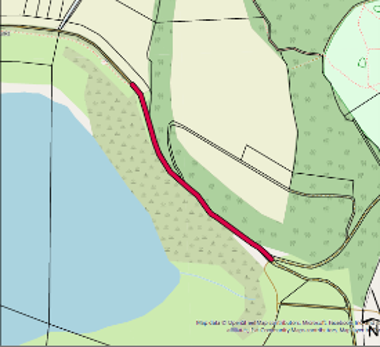
The current estimate for the planned refurbishment of the cycle path below the adventure playground in the Schadeleben area is 510,000 euros. Over a distance of just under 600 metres, between the cycle and information centre and the junction where the farm track branches off towards the adventure playground, the damage caused by tree roots is to be repaired and the surface rebuilt.
The Salzlandkreis will cover all necessary costs up to one million euros for the next phase of the R1 expansion. The town of Seeland will cover any costs exceeding this amount, as well as any expenses that are not eligible for funding. Through the local authority agreement, the project partners will agree not only on this financial arrangement but also on the next steps and respective responsibilities. As soon as the ink on the contract has dried, the Salzlandkreis will apply for the funding provided by the state and will arrange for the planning work for the expansion sections to be contracted out.
At the signing of the contract, Mayor Robert Käsebier said: “We are delighted to have the support of the Salzlandkreis.”
The Europarade Route R1
– which is both the D-Netz Route 3 and the German Unity Cycle Route – runs for 75 kilometres through the Salzlandkreis. In recent years, the district and local authorities have already upgraded many sections with various sources of funding; the Salzlandkreis alone has upgraded 16 kilometres at a cost of 9.2 million euros through its PMO project, using funds from the assets of political parties and mass organisations of the GDR.