
Partnership exchange project between the Salzland district music school and the JPC Barcelona music school
Initiation of an Erasmus+ partnership
Three public concerts, a workshop with participants from three wind orchestra formations as well as visits to the music school locations with instrumental workshops and intensive exchange on pedagogy and music practice for teachers and students are activities that were realised during the four-day exchange between the "Béla Bartók" music school of the Salzland district and the "Juan Pedro Carrero" music school.
From 20 - 24 June 2025, 43 musicians and their instruments travelled from Barcelona to the Salzland district to meet with colleagues in adult education. The contact for the exchange was established on the European EPALE platform as part of an Erasmusplus project. The project in the centre of Saxony-Anhalt was supported by the State Chancellery and the Ministry of Culture of Saxony-Anhalt and the Salzland district, while the trip of the Spanish programme participants was funded by the European Union.
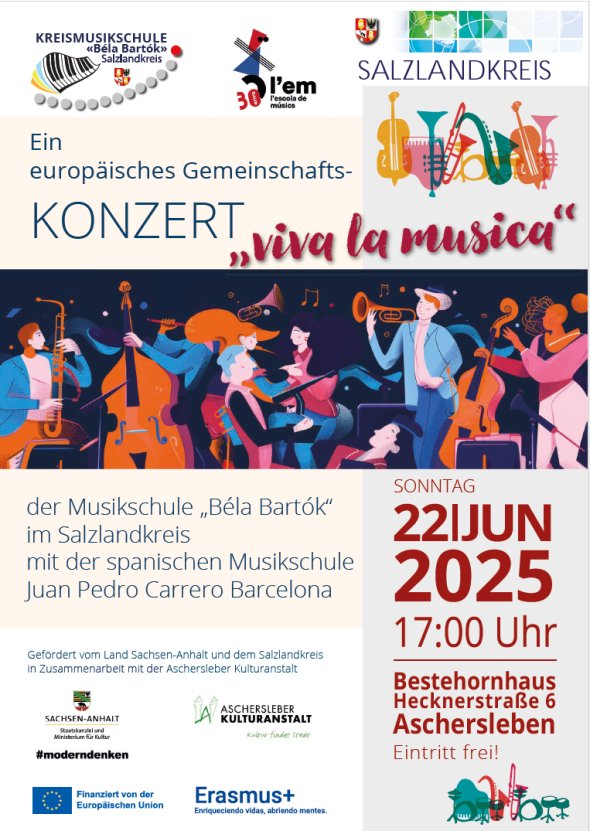
During the public concerts, the participants from Catalonia had the opportunity to familiarise themselves with Aschersleben's participation in the "Féte de la musique" and experience it in practice, as well as get up close and personal with the local audience. Two open-air concerts were held in the Grauer Hof and the garden of the Besthornhaus on Herrenbreite. The contributions of the Spanish music school formations "BIG L'EM" and "Ravelsband" were met with great applause from the audience, who demanded several encores each time and the exchange culminated in the European joint concert in the Bestehornhaus, when more than 70 musicians, including members of the Aschersleben big band under the direction of Paul Seidel, played together.
The music school teachers, as the core addressees of the project, also took the opportunity to exchange ideas with their Spanish colleagues about methodological approaches in music lessons. While German music school lessons have so far tended to focus on children and young people as a target group, the comparison with the private music school in the centre of Barcelona made it clear how successfully music lessons can also be offered to "best agers".
Using a personal example, Spanish participants illustrated their experience of having started learning an instrument at the age of 50. The high quality of the musical contributions confirmed the idea that making music is worth striving for, learning and teaching at any age. Strengthening musical practice is the concern of both educational institutions, according to the tenor, which unites across national borders and finds a universal language of understanding in music.