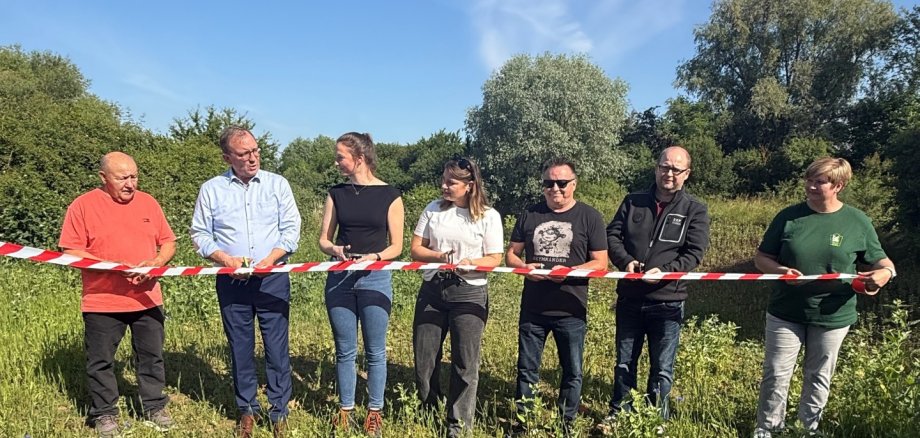
Plötzkau/SLK. With the summer heat on its way, nature in the Zinkenbusch near Plötzkau is now ready: fresh water from the Saale is flowing into the fishing waters along the Saale Cycle Route. The area has been replanted with vegetation following a controlled breach in the dyke, which has reconnected the previously isolated oxbow lake.
“The problems we’ve faced in recent years – high water temperatures, fish deaths and silting at this location – have been a constant concern for us. I am very pleased with the result we have achieved with financial support from the Salzlandsparkasse. It serves both nature conservation and flood protection, which is a boon for the Salzlandkreis as a place to live,” says District Administrator Markus Bauer. He thanks everyone involved for their commitment and cooperation.
The restoration work in Zinkenbusch is a project run by the ‘Unteres Saaletal’ Nature Park Association in close collaboration with the Salzlandkreis district. The association manages the nature reserve of the same name along the River Saale, stretching from north-west of Halle to beyond Nienburg. Its chairman, Tilo Wechselberger, works for the district administration as head of the department for district and economic development and tourism. He is familiar with the project and the technical and financial challenges facing the association from both perspectives.
Initial planning and preliminary studies date back five years, before funding applications were submitted, all the necessary permits under water, waste, soil and nature conservation legislation were obtained, and the firms responsible for planning and construction were found and able to commence work. KUBENS Ingenieurgesellschaft mbH was entrusted with the planning. The nature conservation documentation was drawn up by the nature park itself. Finally, at the start of this year, the company Jäger Spezial- und Tiefbau carried out the construction work.
A breach was created in the dyke between the two oxbow lakes, spanning a length of around 55 metres; the embankments were adjusted and the excavated soil was reused on site. The new connection is intended to protect animals such as beavers and otters, whilst also improving flood defences.
The total cost of the project, including planning services, amounts to 85,000 euros. For the implementation, 40,000 euros in funding was made available from the VDN project ‘for climate protection and biodiversity in wetland habitats in nature parks’ with funding from the “Kaufland Climate Fund, courtesy of Coca-Cola Europacific Partners DE”, as well as 24,000 euros from the Salzlandsparkasse’s profit distribution.