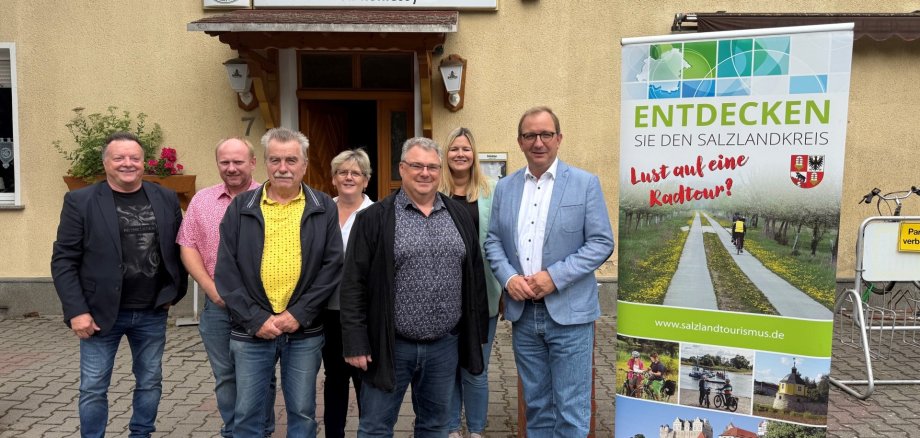
Bernburg/Warmsdorf. “We’ve received confirmation of funding – construction can go ahead in 2028/2029.” When District Administrator Markus Bauer, accompanied by Head of Department Tilo Wechselberger, brought the good news from the Salzlandkreis regarding the Wipper Cycle Route to Warmsdorf, the Mayor of Güsten, Michael Kruse, was also present. For the extension and, in some sections, the new construction of the cycle route over a distance of around three kilometres between Güsten and Amesdorf, Warmsdorf to the Giersleben municipal boundary, the state has allocated a total of 2.6 million euros in funding in its budget for the years 2028/29 to the Salzlandkreis as the project sponsor – federal funds for investment in cycling from the ‘Stadt und Land’ special programme.
This will enable the region to fulfil a long-held ambition and restore the old ‘Schwarzer Weg’ between Güsten and Amesdorf to full passability as part of the Wipper Cycle Route, including the construction of a new bridge. This Wipper Cycle Route runs along the river from Sandersleben for 35 kilometres to Bernburg, where the Wipper flows into the Saale at its mouth. The regional Wipper Cycle Route connects several towns within the Salzlandkreis’s regional cycle route network and provides a link to the supra-regional Saale Cycle Route.
“By upgrading and building new infrastructure, we are therefore strengthening both everyday cycling and our tourist offering, as e-bikes are bringing these places significantly closer together than before,” emphasises District Administrator Markus Bauer. He stresses: “We want people to stay here in our region. To this end, we are gradually creating a sustainable and safe infrastructure.” The District Administrator points to the cycle path running alongside the road between Elbenau and Grünewalde in Schönebeck, which can be built because the state has also allocated more than one million euros for this project. “Together with the Wipper Cycle Path project, we are securing around 3.8 million in funding and investing a further 4.2 million euros in total in our district-wide cycle path infrastructure. The initiatives we are driving forward together under our ‘Salzlandkreis 2030’ future strategy unlock potential and offer further opportunities in the rural area between Halle and Magdeburg. This enables us time and again to secure support from the state and federal governments.”
Michael Kruse, Mayor of Güstens, says: “I am delighted that, by building this cycle path, we are able to fulfil the wishes of the residents and the town council. As a town, we could never have managed this on our own. This link has been long awaited, and now it is finally here! This means that all the towns in the Saale-Wipper municipal association will then be connected by cycle paths.” Furthermore, the mayor is also pleased that, thanks to the agreement, the dispute over the district levy can finally be resolved. “This is a very sensible solution in everyone’s interests.”
As with the project in Schönebeck, the Salzlandkreis, the town of Güsten and the association of municipalities had agreed in advance to settle an old legal dispute with the town regarding the 2017 district levy through a settlement. The final amount in dispute stood at 1.26 million euros. Rather than a dispute with an uncertain outcome, an agreement was reached with a shared aim: to extend the Wipper Cycle Route and rebuild parts of it, provided that the necessary funding is secured. The Salzlandkreis is acting as the project sponsor and provider of pre-financing.
The head of the department responsible for district and economic development and tourism is familiar with the details: The investment required for the work across three sections – from Wipperstraße in Güsten to Amesdorf, including the construction of a new bridge over the Wipper; from Amesdorf to Warmsdorf; and from Warmsdorf to Giersleben – has been estimated at over 2.9 million euros. The Salzlandkreis is contributing 180,000 euros towards the town’s 10 per cent contribution, which the town intends to fund using the federal government’s special infrastructure fund.
Once completed, the town of Güsten will remain responsible for all sections of the cycle path, as has been the case to date. “We have now set up a working group with the town and the Saale-Wipper municipality to support the planning process. It’s a win-win situation when we, as the district, support the local authorities with such projects and take the lead, even if it means taking on a lot of extra work. The project to extend the Wipper cycle path is now also financially secured following the grant approval,” says the head of the specialist department.