Text: Dr Harald Lütkemeier
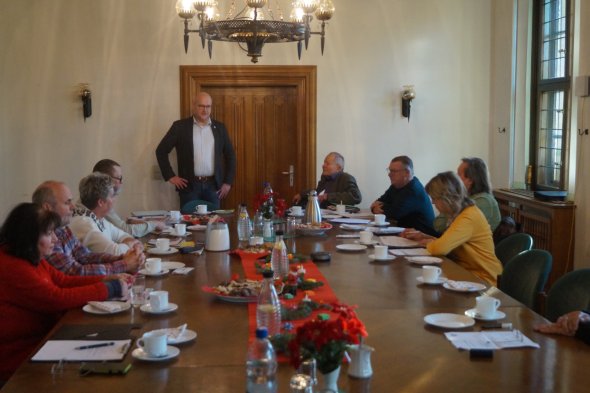
The members of the district senior citizens' council have anchored a wide range of tasks relevant to senior citizens: improving mobility options, accessibility, age-appropriate living, implementing the Care Reinforcement Act, the joint work of young and old as well as services of general interest in rural areas are key topics. The senior citizens are concerned about the future in the villages, support the administrations in further improving the living conditions of older people and in intergenerational work in communication centres. Constant dialogue and cooperation with the Social Affairs, Family and Education Department of the Salzland district administration is an urgent requirement. "We want to inform ourselves in the consultations with specific topics and exchange experiences on possible improvements," emphasised the current chairwoman of the advisory board, Cornelia Stegemann.
In addition to already established highlights, e.g. the Senior Citizens' Days in Bördeland, Aschersleben and Nienburg, the members of the Senior Citizens' Council prepare and actively organise a large number of events in the municipalities. The contributions of the individual members revealed a great deal of voluntary commitment to constructive cooperation with the communities and their senior citizens, and good experiences were shared.
Romy Kleische, social planner in Department II at the Salzland district, presented the Salzland district's care structure report to the members of the advisory board with great commitment. This is based on population data from the Saxony-Anhalt State Statistical Office (Halle) as well as data derived by the employees of the department and forms an important basis for the district care plan for the further implementation of the Care Strengthening Act in the Salzland district. During the presentation of the report and in an emotional discussion, it became clear that there is still considerable potential to be tapped in the four allocated social areas with regard to outpatient and inpatient care, and that the number of people in need of care is increasing. Overall, securing the supply of skilled labour in the care sector requires the joint efforts of all stakeholders involved, further targeted training support, networking of the care sectors, and the care potential of relatives must be supported as far as possible. The district has little or very limited ability to control or react to developments in the care market.
Annemarie Rockmann from the Aschersleben Seniors' Advisory Council expressed her thanks for the valuable analyses, confirmed the recommendations made, reported on planned site inspections in the districts of the town of Aschersleben, the many requirements for improving accessibility, but also for care coordination and the indispensable close contact between seniors and the younger generation in the communities, e.g. in Freckleben. Council member Siegfried Hampe confirmed from his point of view the problems identified in the Stadt Seeland social area. Peter Maier, Staßfurt Senior Citizens' Council, and Christine Pfeiffer, Bernburg Senior Citizens' Council, reported on many events planned with senior citizens in the near future.
The demographic development of the population, the ageing trend (the number of people over 75 is set to rise rapidly over the next few years) and the resulting increase in the need for care, single households, mobility and services of general interest were important topics in the round table, which will be discussed locally by the senior citizens' councils this year.
The senior citizens' councils want to contribute their experience and suggestions to the development of viable solutions. The aim is to use local initiatives to enable social participation in the future, especially for senior citizens in rural areas. In general, it is important to think across generations, to enjoy a longer life together and alongside one another.
The committee consists of one representative from each of the single and association municipalities and meets regularly. The aim is to keep the interests of the older generation present in social discourse and thus represent the interests of senior citizens.