The "Climate protection through cycling" funding programme of the Federal Ministry for the Environment, Climate Protection, Nature Conservation and Nuclear Safety supports exemplary regional investment projects for climate protection by strengthening cycling.
The funding project
Funding data
Funding measure: NKI: Cycle bridge over the Saale river and sustainable mobility services in the municipality of Barby/district of Groß Rosenburg
File reference: 67KBR0144
Grant notification dated: 17 December 2024, last amended by notification dated 22 August 2025
Implementation period: 1 March 2025 – 28 February 2029
Executing agency: Salzlandkreis - FD 41 District and Economic Development and Tourism
Partners involved:
- Salzland district
- the town of Barby
- the district economic enterprise of the Salzland district
- the Magdeburg Waterways and Shipping Authority (WSA Magdeburg)
- the Saxony-Anhalt State Office for Flood Protection and Water Management (LHW)
- Nahverkehrsservice Sachsen-Anhalt GmbH (NASA GmbH)
- the Saaleradweg e.V
- Federal Ministry for the Environment, Climate Protection, Nature Conservation and Nuclear Safety and the National Climate Initiative
Initial situation
Due to the location west of the Elbe and north and south of the Saale, the question of a continuous connection of all districts, e.g. to the basic centre of Barby (Elbe), is a particular challenge. Bridge crossings over the Elbe only exist in Schönebeck (Elbe) (approx. 12 km away) and in Dessau-Roßlau (approx. 28 km away); the nearest bridge over the Saale is in the town of Calbe (Saale). The town of Barby currently operates and maintains 3 ferries: The Barby Elbe ferry on the L 51 state road, the Breitenhagen Elbe ferry on the L 149 state road and the Groß Rosenburg Saale ferry on the K 1243 district road. Due to the high operating costs, the municipality has repeatedly requested support for the ferries from the state of Saxony-Anhalt. All three ferries are yaw rope ferries, which are particularly dependent on sufficient water levels. For this reason, the operation of the ferries has had to be completely cancelled several times in recent years, as the ferries cannot be operated during high water, low water and ice. For example, the ferry did not operate on a total of 152 days in 2019.
If the ferries are closed, short connections will no longer be available for the residents of the villages south of the Saale. In this case, all of these places would have to take the much longer route via the town of Calbe, which would also apply to schoolchildren and commuters. The Protestant secondary school and the majority of medium-sized companies in the unified municipality are located in Barby. A total of 1,000 jobs in the towns of the unified municipality lead to commuting relationships between the individual towns. The Saale cycle path and a section of the Elbe cycle path also run across the ferry. During the 213 days of operation in 2019, a total of 2,799 cyclists were counted on the Groß Rosenburg ferry.
As distances of 9 to 16 km have to be covered between the towns and railway stops even with a cycle bridge, a pedelec or e-bike is recommended for everyday use. However, there are currently no secure parking facilities and no charging options for these bikes.
Objectives and contents of the project
The creation of a Saale crossing for cyclists and pedestrians near Groß Rosenburg is intended to overcome mobility deficits in a rural area with a peripheral location and natural barriers (rivers). The new infrastructure measure and the associated shortening and permanent usability of connections, especially for cyclists, is intended to deliberately put this environmentally friendly means of transport in a better position than motorised traffic/vehicles. In addition, the construction of bicycle boxes and charging stations at the Sachsendorf and Gnadau stops will create conditions that can provide an everyday alternative to motorised private transport/vehicles. Journey times can be significantly reduced through the use of pedelecs and e-bikes, which essentially supports the decision in favour of this climate-friendly mode of transport. This approach also supports the wider use of the services for all age groups; senior citizens can also cover these relatively long distances with pedelecs/e-bikes.
This can also convey the positive characteristics of cycling, such as exercise, fresh air and experiencing the countryside, and make an important contribution to reducing greenhouse gas emissions - this time in rural areas. In this way, the measures should also contribute to increasing the proportion of cycling in rural areas and support the climate protection goals of "motivating as many people as possible to use climate-friendly mobility" and "mobility transition".
The project pursues the following project and climate protection goals:
- Permanently usable connection
- Shortening the route between the districts of the town of Barby
- Shifting traffic from motorised private transport to cycling
- Sustainable offer instead of long diversions routes
- Enabling cycling for all age groups
- Raising awareness for climate protection
- Additional opportunities for tourist offers
With the construction of the necessary and additional cycling infrastructure and the expansion of services through cycle parking facilities and charging stations for pedelecs/e-bikes, decisive impetus will be given to achieving the climate protection goals in the region. The measures have a high potential for convincing the citizens of the unified municipality and beyond of the need for climate-friendly mobility through public relations measures. It clearly distinguishes itself from the investments planned in the cycle path concept to improve the local infrastructure and thus represents an innovative regional model project.
The main climate protection goal is to reduce greenhouse gas emissions:
- In the short term: by shortening connections between villages on both sides of the Saale, especially for commuters and everyday cyclists in the event of a diversion (if the Groß Rosenburg ferry is not in operation) and
- In the medium and long term: by changing the mobility behaviour of citizens in everyday life and in their leisure time.
Description of the measure
Cycling is only possible at all times between the villages to the south. Due to the need to cross the Saale or the Elbe to reach the northern villages, it is not possible to use bicycles at times of low water, high water, ice or operational disruptions to the ferry. In 2019, the Groß Rosenburg ferry was cancelled on 119 days, i.e. for a total of around 4 months, mainly due to low water. Due to the much longer detours via Calbe, local residents primarily use their cars during this time, as public transport services are also not attractive.
Furthermore, there are no facilities for using bicycles for everyday transport at Gnadau and Sachsendorf railway stations, such as secure parking facilities, charging facilities, etc. Due to the sometimes long distances, the fear of bicycle breakdowns is also an obstacle to the decision to cycle.
For this reason, the following components were included in the project:
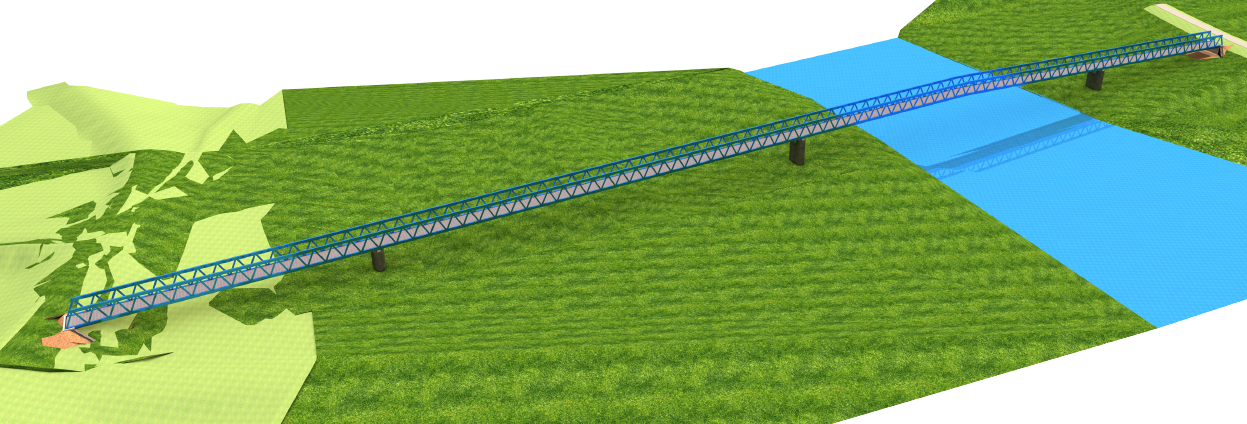
- New construction of a cycle and pedestrian bridge over the Saale near Groß Rosenburg at approx. Saale km 9.5
- Construction of the path connection from the north side of the bridge (Saaledeich on the left) to the connection to the municipality's path extension route
- Connection of the bridge south of the dyke on the right-hand side to the rural path (Saaleradweg)
- Construction of a bicycle service station with various parking facilities (open, lockable), bicycle boxes, charging stations and other services (bicycle tube machine, self-service station, tourist information) at Gnadau railway station
- Construction of a bicycle service station with various parking facilities (open, lockable), bicycle boxes and charging stations
The cycle path on the bridge will have a continuous width of 3.00 metres. The other measures (No. 4 and 5) are intended to bring a modern quality of service for the everyday use of bicycles to rural areas. Modern parking facilities with high user acceptance at the Sachsendorf and Gnadau railway junctions are not commonplace in this area. However, these are essential for the decision in favour of bicycle use. The charging and service offerings are intended to create a comprehensive offering that also supports the use of bicycles for senior citizens with e-bikes into old age.
Climate protection effect
The calculation is based on the traffic relationships between the towns south of the Saale and the basic centre of Barby. It was taken into account that various matters can also be dealt with in the towns of Aken and Calbe, which are closer if the ferry is closed. For this reason, only 10 % of the population travelling to Barby daily was assumed. Proportions that would use public transport were not included due to the complicated connections (at least 1-3 changes, only on-call bus, journey time between 1.5 - 3 hours).
As a result, 264 journeys between the towns south of the Saale are assumed per day in everyday traffic, of which a 10% potential for switching to cycling is seen. According to the KfW survey "Transport transition in Germany needs differentiated approaches in urban and rural areas", 47% of respondents in rural communities could still imagine switching to cycling if the infrastructure were better. However, there are restrictions for older people and for longer journeys. The proportion of all journeys made by bicycle in a bicycle-friendly city like Münster is currently 30%. At present, it can be assumed that the share of bicycle use in the area of the localities addressed here is less than 1%. Due to the age structure of the population, the length of the necessary routes, but also the increasing sensitisation of the population to climate protection and other conditions such as the cost increases for fossil fuels, a potential switch of 10% of daily journeys is assumed here. This 10 % is still below the average cycling mode share in Saxony-Anhalt (2017 = 11 %).
Taking into account the parameters specified in the "Instructions for calculating the GHG reduction" for the "Climate protection through cycling" funding call, a daily reduction of 460.3 car kilometres and a daily greenhouse gas reduction (GHG reduction) of 96.0 kg CO2 could be achieved. The calculation of the annual GHG reduction was based on a total of 150 days. This results in an annual saving of approx. 14.4 tonnes. The results are summarised in the table.
After completion of the construction work and the public relations measures, it is assumed that the GHG reduction values will be achieved approx. 2 years later.
Latest news
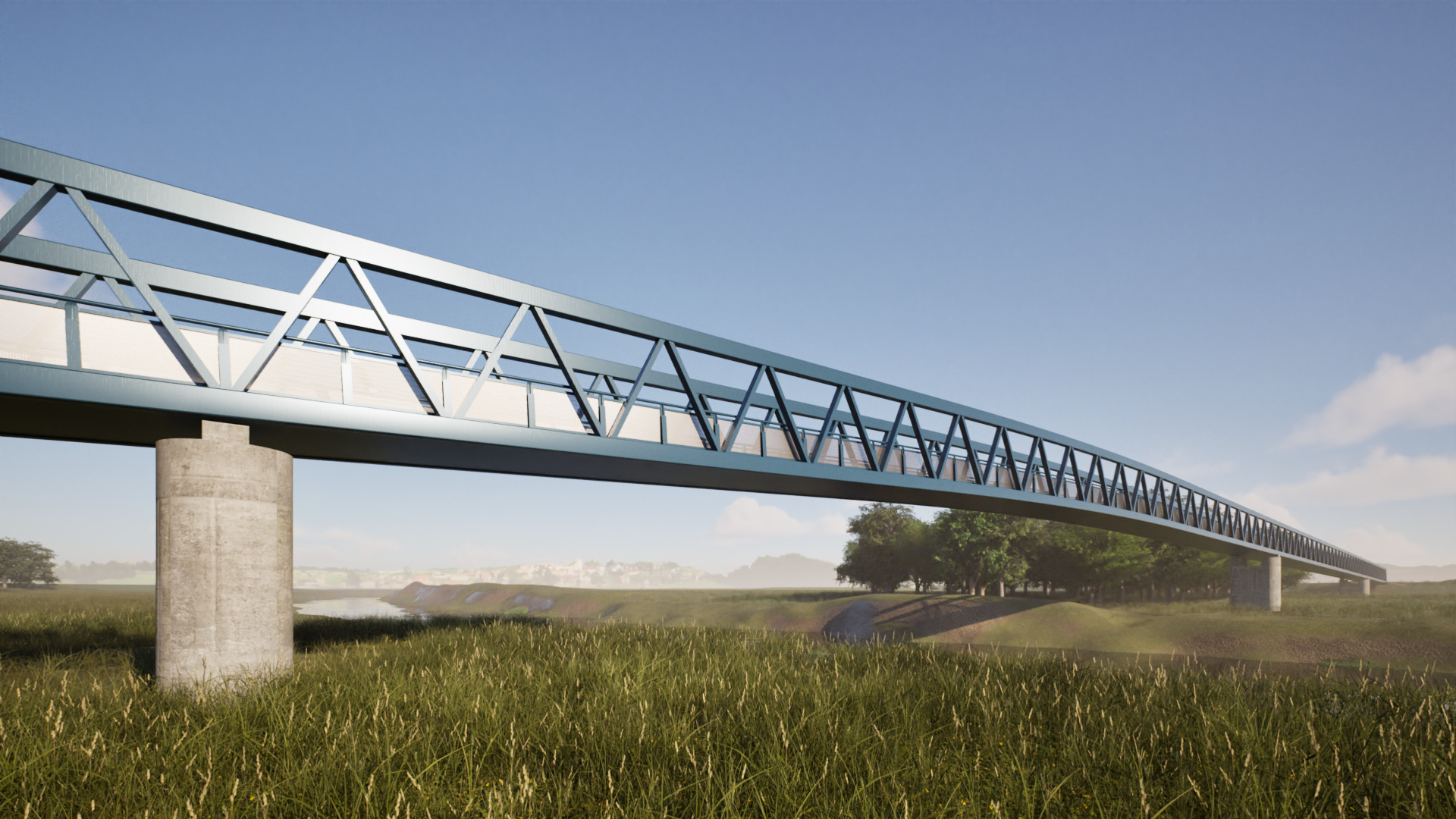
Survey completed | This is what the new pedestrian and cycle bridge will look like!
The decision has been made: The new pedestrian and cycle bridge over the Saale near Groß Rosenburg will be blue!
As part of the survey on the choice of colour for the future pedestrian and cycle bridge, interested parties had until 30.06.2025 to cast their votes. A total of 342 valid votes were analysed. The majority of participants - 39.77% - were in favour of the colour blue. Green received 31.29 %, while 28.94 % of the votes were in favour of anthracite.
The response to the survey shows a keen interest in municipal projects among the population: The largest participation came from the town of Calbe (Saale), followed by Barby (Elbe) and Bernburg (Saale). Votes were also received from other parts of Germany, including North Rhine-Westphalia and Berlin.
The Salzlandkreis would like to thank all citizens for their participation and commitment.
Now that the colour decision has been made, the planning can move forward. The pedestrian and cycle bridge in blue will not only be functional, but also a real eye-catcher for the region.
Press releases