© sußmann+sußmann
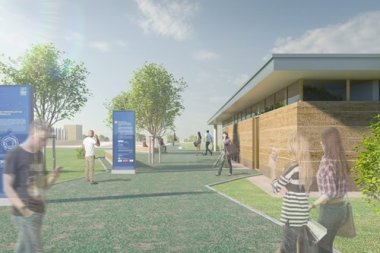
Planning diagram of the Pömmelte Ring Shrine Tourist Information Centre
The Pömmelte ring sanctuary has quickly become a tourist attraction in Saxony-Anhalt. The approximately 10,000 square metre site has since been continuously developed in terms of infrastructure and tourism. The increasing number of visitors and growing regional and national interest are encouraging the Salzlandkreis district and its project partners to further develop the site in the future. The construction of the tourist information centre is intended to increase the attractiveness of the site and convey knowledge about the approximately 4,000-year-old circular ditch system in a visitor-friendly manner.
The planned information centre at the Pömmelte Ring Sanctuary is the result of an architectural competition initiated by the Salzlandkreis district. It is a multifunctional building that will stand out thanks to its clay construction, among other features. The design was created by the architectural and engineering firm sußmann + sußmann from Magdeburg.
© sußmann+sußmann
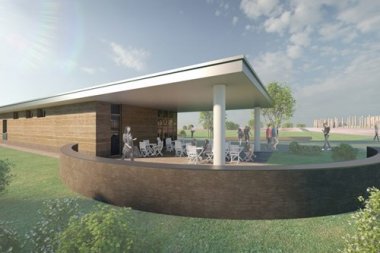
Planning diagram of the Pömmelte Ring Shrine Tourist Information Centre
The Pömmelte ring sanctuary is to remain an integral part of the district's tourism and education landscape. Thanks to funding from the Federal Government Commissioner for Culture and the Media and the state of Saxony-Anhalt, the building will be equipped with modern information and communication technology. This will make it possible in future to network regional and national partners and stakeholders and to present offers and information in a transparent and target group-specific manner.
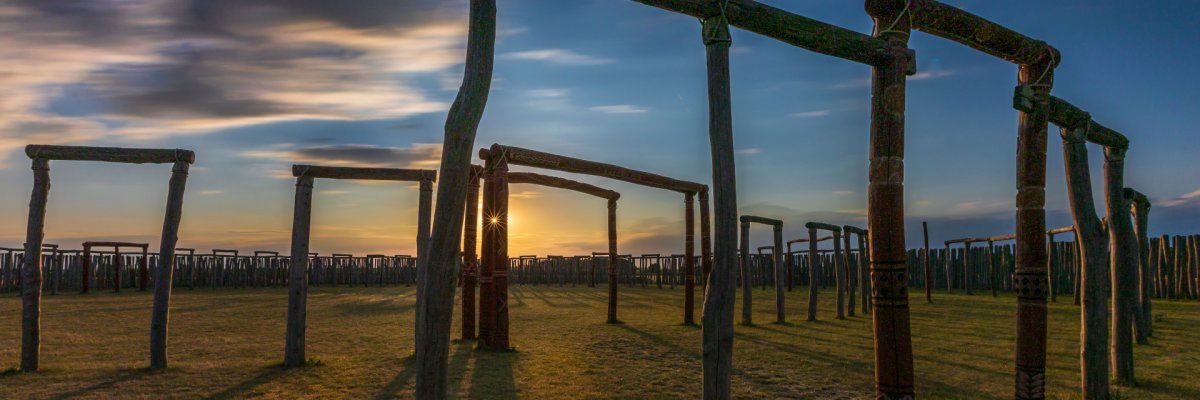
The Pömmelte ring sanctuary
With the discovery of the Pömmelte/Zackmünde ring sanctuary south of the state capital Magdeburg, the first ritual-religious structure of the Corded Ware and Bell Beaker cultures and the Aunjetitz culture in Central Europe has been found.Zackmünde, south of the state capital Magdeburg, the first ritual-religious structure of the Corded Ware and Bell Beaker cultures and the Aunjetitz culture in Central Europe has been found, allowing conclusions to be drawn about the world view and beliefs of this era, which was so decisive for the development of Europe.
Salzland district
The Pömmelt ring shrine
The prehistoric circular ditch near Pömmelte/Zackmünde was discovered as early as 1991 by aerial prospection and excavated between 2005 and 2008 in a cooperative project between the Martin Luther University Halle-Wittenberg and the Saxony-Anhalt State Office for the Preservation of Monuments and Archaeology. What came to light was a complex ritual site arranged in concentric circles, dating from around the same time as the famous English Stonehenge monument.
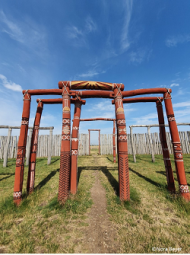
The complex was reconstructed on the original site between 2013 and 2017 on behalf of the Salzland district. It consists of seven interlocking rings, circular wooden palisades, earthen ramparts and ditches. These are interspersed with gates that bear witness to ancient annual festivals.
Since its opening in 2016, around 25,000 visitors a year have experienced the cultural, astronomical and archaeological significance of the ring sanctuary. Today, colourful palisade trunks with mythical symbols and skulls carved out in relief are reminders of the rituals of the Stone Age people. A 9 metre high viewing platform offers a perfect overview of the approximately 10,000 square metre area. The original archaeological finds can be marvelled at in the Salzland Museum in Schönebeck.
This project is sponsored and supported by:

Press releases on the project
08.05.2023: New impetus for the Ring Shrine as an educational and event venue - Salzlandkreis opens the tourist information centre. What makes the building so special
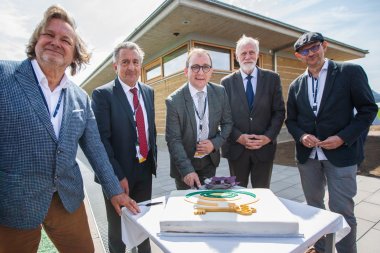 Salzland districtState archaeologist Harald Meller, President of the State Parliament Dr Gunnar Schellenberger, District Administrator Markus Bauer, Minister of State and Culture Rainer Robra and architect Carsten Sußmann symbolically cut a cake with the logo of the Ring Shrine at the opening of the TIZ
The exterior is both traditional and forward-looking, while the interior is modern - the Salzland district's new tourist information centre (TIZ) at the Pömmelte ring sanctuary combines the past and the future thanks to its rammed earth construction and digital technology. The building was officially opened on Friday, 5 May after around three years of construction by District Administrator Markus Bauer, President of the State Parliament Dr Gunnar Schellenberger, Minister of Culture Rainer Robra and State Archaeologist Prof. Harald Meller.
Built with funding from the Federal Government Commissioner for Culture and the Media and the state of Saxony-Anhalt, the TIZ will invite visitors to the Ring Shrine to linger and recharge their batteries, but will also serve as a place of education. The building cost around 2.7 million euros. It is barrier-free and family-friendly.
At the opening of the TIZ, District Administrator Markus Bauer said to around 200 invited guests from politics, business and society: "Thanks to the construction and digital possibilities, we now have another reason to visit the Ring Sanctuary and thus the Salzlandkreis district. This will provide further impetus for the promising development of the region as an attractive residential, business and scientific location in terms of tourism and the economy." The Ring Sanctuary could be the starting point for a visit to Bernburg Castle, the Neo Rauch Graphic Foundation in Aschersleben or other highlights in the Salzlandkreis district.
State Parliament President Dr Gunnar Schellenberger said: "The opening of the new TIZ represents another milestone. Thanks to the additional offerings, we are now playing in the same league as other tourist attractions in Saxony-Anhalt, Germany and even Europe, in addition to the cultural and historical significance of the site." He is certain that the clay building itself will also become a worthwhile destination for architecture enthusiasts. And for more comprehensive tourist development in the future, the archaeological research of the past five years has provided more than enough sensations. Minister of State and Minister of Culture, Rainer Robra, said: "Pömmelte is a cultural beacon with increasing national appeal. Today, with the opening of the TIZ, the success story of the ring sanctuary continues. The state was happy to contribute to the financing, because the centre is both future-oriented and sustainable as another important element of the Skyways in Saxony-Anhalt." [...]
26.04.2023: Opening of the tourist information centre at the Ring Shrine with sounds from the Stone Age
The Salzlandkreis district will be celebrating the opening of the new tourist information centre, built from rammed earth, at the Pömmelte Ring Sanctuary in style on Friday afternoon, 5 May, and Saturday, 6 May. "Our new tourist information centre significantly enhances the Ringheiligtum for visitors from all over the world. We are delighted to have reached this milestone in the development of the Ringheiligtum. We want to share this joy with everyone," says District Administrator Markus Bauer, encouraging people to visit the following weekend.
From concerts with international artists and moonlight tours of the Ring Shrine to performances by local artists, there is plenty on offer on the first two days. There will also be a variety of events at the Ring Shrine in the days after [...]
15.09.2022: Review of the 2022 Ring Shrine season
The last events of the season into October will increase the number of visitors to the Ring Shrine. However, this will not wipe away the trend for 2022, as it will for comparable cultural tourism facilities in general: Growth has not continued. The monthly figures fluctuate. Up to and including August, just over 26,000 visitors were counted. At the same time last year, around 32,000 had already made their way to the Ring Shrine, and by the end of the year over 44,000 had done so. The visitor numbers for this year would have been different with the planned opening of the new tourist information centre. However, due to construction delays, this can no longer be celebrated this year.
As the operator, the Salzland district regularly informs the district council about current developments, the next time in the specialist committees in September. Most recently, the district administration presented a utilisation concept for discussion in the summer, which will be further qualified and is intended to secure the development of the Pömmelte ring shrine. The TIZ (Tourist Information Centre) plays a major role in this.
The planned opening date for the TIZ at the beginning of October cannot be met, according to Petra Czuratis, the responsible head of staff at the district administration. Due to supply bottlenecks, the construction process was and still is significantly disrupted, resulting in delays and increased construction management costs. As a result, completion will probably have to wait until next spring. An extension of the project period had been applied for from the funding body. Talks on financing with the Saxony-Anhalt Investment Bank are continuing. While the special rammed earth shell and the basic installation for heating, water and sewage are complete, the finishing trades are working on electrical engineering, drywall and timber construction and tiling. The district administration plans to publish the last two tenders for the interior fittings and the adaptation of the outdoor facilities in the next few days.
Construction costs for the tourist information centre were estimated at around 1.8 million euros, 90 per cent of which was funded by the federal government and the state of Saxony-Anhalt. It is foreseeable that the money will not be enough. Negotiations are ongoing.
The federal and state governments are also providing funding to equip the TIZ with future-proof IT infrastructure. The technical equipment will be particularly geared towards providing innovative information about the Ring Shrine and educational programmes.
District Administrator Markus Bauer says: "Our plans for the ring sanctuary will definitely promote tourism in the Salzlandkreis district and help to establish the region as an attractive place to live, work and study. The more people visit the Salzlandkreis district, the more people will then be able to report on their positive experiences here." [...]
07.09.2021: Liberated from the wooden shell - earth building 2.0
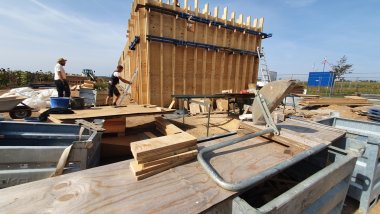
Since July, a good 50 volunteers have tamped 130 tonnes of clay into a wooden formwork. Contemporary architecture, built almost like in grandpa's day and thousands of years ago: with a lot of physical labour and the building materials that nature provides. The elongated building stands directly on the Early Bronze Age mega-settlement at the gates of the Pömmelte ring sanctuary and will serve as a visitor centre once it is completed. The clay walls have now been freed from the wooden shell and are being allowed to dry slowly before the flat concrete roof is put on. [...] From autumn 2022, visitors from all over the world can be welcomed to the Pömmelte ring sanctuary with a visitor centre. The special thing about this building is that clay plays a key role here. 130 tonnes of clay were used for the walls over the summer. After the Chapel of Reconciliation in Berlin, completed in 2000, Central Germany, which is known far beyond its borders for its traditional clay building heritage, can now also boast a contemporary realisation of the traditional clay building technique. Until the end of the 1950s, building with earth was widespread in central Germany. Thousands and thousands of farmsteads and small courtyards, as well as stately residential buildings, later apartment blocks and terraced houses and public buildings were constructed with solid walls made of clay. Such building projects could be realised primarily with the help and personal contribution of the subsequent owners and in a community effort.
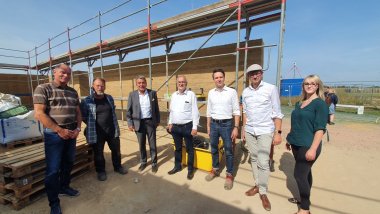 Salzland district(from left to right): Detlef Büttner, Building Regulations and Building Construction Department, Salzlandkreis, Hubert Heinrichs, responsible local earth builder and trainer, Dr Gunnar Schellenberger, President of the Saxony-Anhalt State Parliament, Dr Alfred Reichenberger, Saxony-Anhalt State Office for Monument Preservation and Archaeology, Prof Christof Ziegert, earth building expert, Dachverband Lehm e. V., Carsten Sußmann, architect from the architectural firm responsible for the project, Nora Beyer, Digitalisation and Innovation Office at Salzlandkreis.
The construction in Pömmelte would also not have been possible without the commitment and courageous actions of all those involved. As the property developer, the Salzland district made a conscious decision in favour of the pioneering architectural design by sußmann + sußmann, Magdeburg. The stone and bronze age buildings at the ring sanctuary were built 4,000 years ago using clay and wood. The rammed earth technique, in which layers of earth-moist clay are filled into a wooden formwork and compacted, has been widespread in central Germany since the end of the 18th century and is once again favoured in modern architecture. Thanks to the tireless efforts of the Dachverband Lehm e.V., rammed earth construction is once again eligible for approval today. For over 20 years, the association has been developing new DIN standards, guidelines and quality standards for earth building and is involved in further training for specialised craftsmen. The building site in Pömmelte was also used to provide certified earth builders with further training in rammed earth construction. After all, the demand for earth buildings is booming. No other building material is as sustainable, energy-saving and healthy to live in as earth. This is probably one of the reasons why the GOLEHM initiative, which is committed to earth building in central Germany, was able to recruit almost 50 volunteers for the strenuous work in Pömmelte. Students of architecture, heritage conservation and engineering spent nine weeks raising the walls with interested amateurs and professionals under the guidance of Hubert Heinrichs, an experienced expert in rammed earth construction. He was already entrusted with the reconstruction of the Roman two-storey craftsmen's houses in the Xanten Archaeological Park (North Rhine-Westphalia) in 2007.
Today, in the presence of the President of the State Parliament, Dr Gunnar Schellenberger, the clay walls were freed from the formwork. The individual tamped layers, each a good 10 centimetres high, are clearly visible, and the slightly different colouring of the clay gives the monolith its structure. The wall is not only climate-friendly, but also aesthetically pleasing. But before it can finally be admired, it will be scaffolded for the next two months so that it can dry and bear the weight of the concrete roof for the next 500 years.
Participating companies:
- Property developer: Salzlandkreis
- Architectural services: sußmann + sußmann, Magdeburg
- Structural design, specialist planning for earth building: ZRS Ingenieure, Berlin
- Execution clay construction: Heinrichs carpentry, Hiddenhausen
Further information can be found under the following links:
https://sussmann.biz/projekt/ringheiligtum-poemmelte-errichtung-eines-informationszentrums/
https://www.golehm.de/
https://www.dachverband-lehm.de/24.06.2021: Laying of the foundation stone at the Pömmelte ring shrine
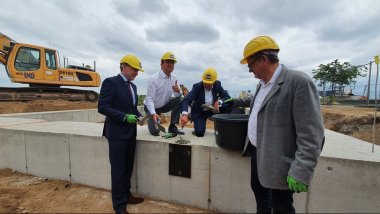 Salzland districtFrom left to right: Thomas Wünsch, State Secretary of the Saxony-Anhalt Ministry of Economic Affairs; Markus Bauer, District Administrator of Salzlandkreis; Dr Gunnar Schellenberger, State Secretary of Culture of Saxony-Anhalt; Prof. Dr Harald Meller, State Archaeologist of Saxony-Anhalt
The basement is complete, and the outlines of the future forecourt are already visible. Now, the official laying of the foundation stone for the new tourist information centre at the Pömmelte Ring Sanctuary has also been completed. District Administrator Markus Bauer, State Secretary for Culture Dr. Gunnar Schellenberger, State Secretary for Economic Affairs Thomas Wünsch and State Archaeologist Prof. Dr. Harald Meller symbolically picked up their trowels on Thursday.
24.08.2020: Presentation of the IT funding decision
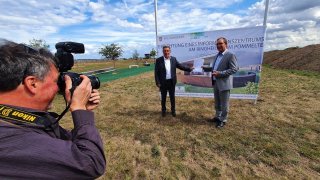 Salzland districtFrom left: State Secretary for Culture Dr Gunnar Schellenberger and District Administrator Markus Bauer
Traditional on the outside, ultra-modern on the inside – this is what the tourist information centre at the Ring Sanctuary will look like in future. The financial requirements are now fully in place. On Monday afternoon, District Administrator Markus Bauer received the funding approval for the planned IT equipment from State Secretary for Culture Dr Gunnar Schellenberger. The total amount of funding is €750,000. The funding comes from the Federal Government Commissioner for Culture and the Media and the state of Saxony-Anhalt.
District Administrator Markus Bauer thanked the funding organisations for their great support. He is convinced that the new building will enormously expand the experience possibilities at the Ring Shrine. "The multimedia possibilities are unimaginable and will surprise visitors. With the tourist information centre, we want to reach all age groups and all interest groups." The new building could therefore help to increase the length of time visitors spend in the Salzland district, says Markus Bauer. "This will then benefit the region as a business location." At the handover ceremony, State Secretary for Culture Dr Gunnar Schellenberger said that the visitor numbers to date are proof of the appeal of the reconstruction of the millennia-old cult site, which is now known as the "German Stonehenge". Around 110,700 visitors have been recorded by the Salzland district, which is responsible for the site. "The new tourist information centre will contribute to a contemporary and appealing presentation of our history," said the State Secretary for Culture. The state is happy to support the project at the Ring Shrine, which is now part of the nationally significant "Himmelswege" tourist route. The foundations for the tourist information centre will be laid in the coming weeks and the clay building will be completed next year. As soon as the building is completed, the interior work, including state-of-the-art IT equipment, will begin. The concepts for this are currently being developed by the Salzland district. The new building should be open to visitors by the beginning of 2022 at the latest. The Salzland district operates and develops the unique tourist facility in collaboration with the State Office for the Preservation of Monuments and Archaeology. The ground-breaking ceremony for a tourist information centre took place only recently.
22.07.2020: Ground-breaking ceremony at the Pömmelte ring shrine
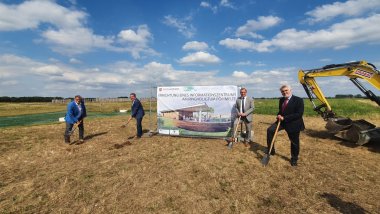 Salzland districtSaxony-Anhalt Economics Minister Professor Armin Willingmann, State Secretary for Culture Gunnar Schellenberger and State Archaeologist Professor Harald Meller symbolically cut the first sod together with District Administrator Markus Bauer (photo from left: H. Meller, G. Schellenberger, M. Bauer, A. Willingmann).
On Wednesday, 22 July 2020, State Archaeologist Prof. Harald Meller, State Secretary for Culture Dr. Gunnar Schellenberger, District Administrator Markus Bauer and State Minister of Agriculture Prof. Armin Willingman gathered at the Pömmelte Ring Sanctuary for a symbolic ground-breaking ceremony for the future construction of the Tourist Information Centre.