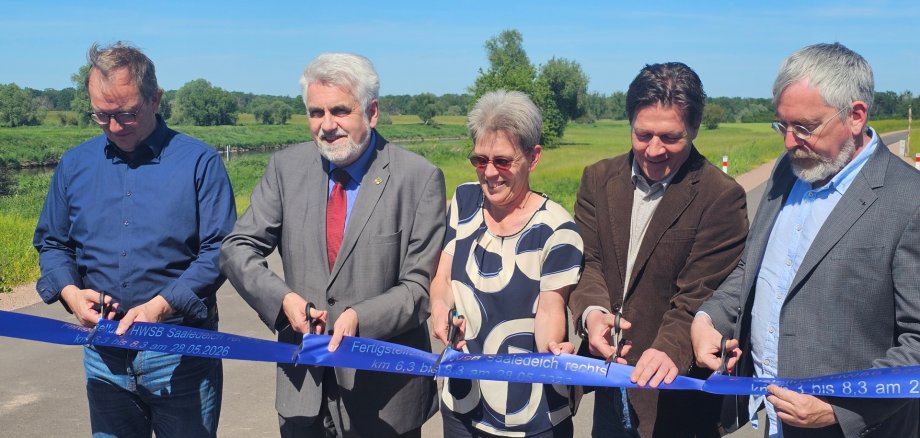
Barby. A major milestone in the development of top-class flood protection in the Salzlandkreis district: Environment Minister Prof. Dr Armin Willingmann, District Administrator Markus Bauer, Barby’s Mayor Dr Jörn Weinert and the Director of the State Agency for Flood Protection and Water Management (LHW), Martina Große-Sudhues, officially inaugurated the final section of the right-bank main dyke between Calbe (Saale) and Barby a few days ago, which has now been fully renovated to DIN standards over a total length of around 14 kilometres. The approximately two-kilometre-long section of the Saale dyke near Groß Rosenburg has been repaired over the past 15 months; around 4.2 million euros in EU funding was invested in the project. The dyke is designed to withstand an extreme flood event that statistically occurs once every 100 years.
Environment Minister Willingmann emphasised: "With the closure of the gap in the important dyke on the right bank of the Saale, the people in Groß Rosenburg, Klein Rosenburg, Patzetz, Lödderitz, Breitenhagen and the communities behind them are now protected from extreme flooding in the best possible way. This is a positive signal, especially in view of the severe damage in the region in the wake of the floods of the century in 2002 and 2013." In June 2013, the Saale dyke near Breitenhagen broke just before the Saale flowed into the Elbe. At that time, around 85 square kilometres were flooded; personal injuries were prevented by evacuations.
District Administrator Markus Bauer thanked the state government and LHW for their commitment to the region. He spoke of a milestone and a sustainable investment in the future. "The population in the region is better protected against flooding thanks to the new standards." He also recalled the commitment of so many helpers who lent a hand during the floods. The district administrator also emphasised the cooperation between the state, the Salzland district and the town of Barby with regard to the cycle path connection. He said that it had been an excellent success in combining flood protection with tourism. "Cyclists can discover a really charming landscape along the dykes. There are some outstanding destinations such as the Pretziener Weir or the Ring Shrine."
Barby's mayor Dr Jörn Weinert expressed his gratitude for the state's support. "This kind of support for local people cannot be taken for granted everywhere. With the completion of the work on the dykes, the citizens have a better sense of security again." He also thanked the Salzland district for its cooperation with regard to the use of the dykes for tourism. "With the planned cycle bridge near Groß Rosenburg at the latest, they will provide further impetus for cycle tourism in the region."
The officially opened two-kilometre section of dyke near Groß Rosenburg was raised and equipped with a dyke crest path and a dyke defence path. Significant archaeological finds were also made during the work, including a fully preserved urn containing human remains that is at least 4,000 years old, as well as evidence of prehistoric and early historical settlements. The renovation of the main dyke on the right bank of the Saale was financed by the European Regional Development Fund (ERDF); a total of around 28 million euros was spent on the 14 kilometres.
Approximately one hectare of the areas sealed during the renovation of the section near Groß Rosenburg will be replanted with shrubs and trees such as field maple, blackthorn and wild apple. In this context, three new habitats for sand lizards were also created. The replacement measures were carried out in consultation with the lower nature conservation authority of the Salzland district.
The focus is now shifting to the main Saale dyke on the left bank, where renovation work is still underway along a stretch of around 8.4 kilometres. In addition, the ‘River, Nature, Life’ programme is preparing further potential sites for two dyke relocations (Beesenlaublingen and Tornitz) and for a flood polder (Calbe). In future, these are intended to help mitigate the effects of advancing climate change and extreme flood events.
A total of around 127 million euros has been invested in improving flood protection in the Salzland district since the flood of the century in 2002. To date, 13 measures have been completed (such as the closure of the Gottesgnaden dyke gap and the relocation of the Lödderitzer Forst dyke); 5 further measures totalling around 23 million euros are currently being implemented. In addition, 19 measures are being planned or prepared; a further 89 million euros are to be invested here.