Gatersleben. The Green Laboratory at the Gatersleben research site is the go-to place for school pupils to carry out experiments and learn about modern plant biotechnology outside the usual classroom setting.
"It's a truly exceptional programme throughout Germany, and therefore a valuable facility for us in the Salzland district that has a positive impact on the entire education and science location. We really appreciate the work," emphasised District Administrator Markus Bauer during his visit to the school laboratory this week. "We want the success story to continue and will continue to support it to the best of our ability," added savings bank board member Hans-Michael Strube.
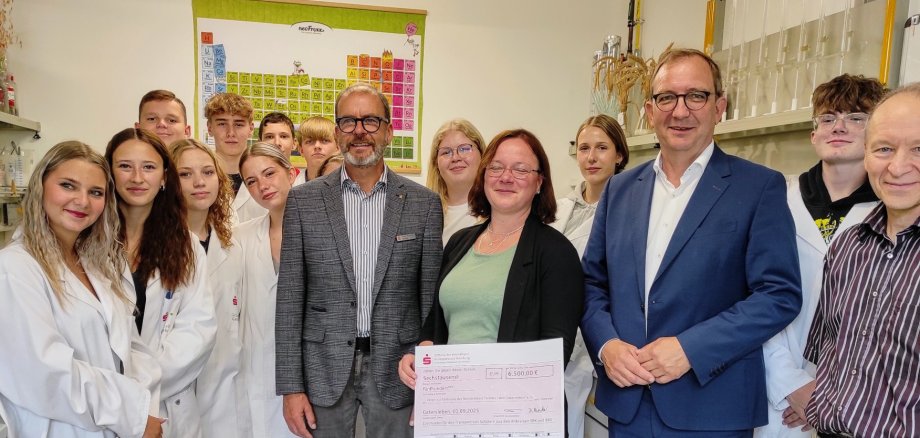
On this day, Hans-Michael Strube and Markus Bauer were the bearers of the cheque for 6,500 euros from the foundation of the former Kreissparkasse Bernburg. The donation at the beginning of the school year is intended as a contribution towards the travel costs incurred by the girls and boys from the district to Gatersleben.
They were greeted with joy and gratitude by laboratory manager Dr Sandra Färber (centre) and Professor Nicolaus von Wirén (right), Chairman of the association for the promotion of the "Grünes Labor Gatersleben" school laboratory. The pupils from a tenth-grade class at the "Leben Lernen" secondary school in Schneidlingen were also delighted. They also travelled to Gatersleben and took advantage of the opportunities offered by the Green Laboratory with its expert and dedicated staff. Where else could the DNA of a standard banana be isolated so easily but so professionally?"
Background
The Green Laboratory in Gatersleben is the only school laboratory in Germany specialising in plant biotechnology. It welcomes more than 5,000 visitors every year. The aim of the facility is to offer children and young people from Saxony-Anhalt, and beyond, an opportunity to supplement their regular school lessons and to enable them to engage with modern research, particularly in the field of plant biotechnology.
One of the main aims is to awaken the interest of children and young people in nature and their environment, to make them curious about the phenomena of nature and to encourage them through their own practical activities to recognise the rules and laws behind the phenomena and to encourage them to treat nature responsibly. This is linked to the second focus of the Green Lab, namely to make a direct contribution to career guidance and preparation and thus to counter the impending shortage of skilled workers trained in the natural sciences.