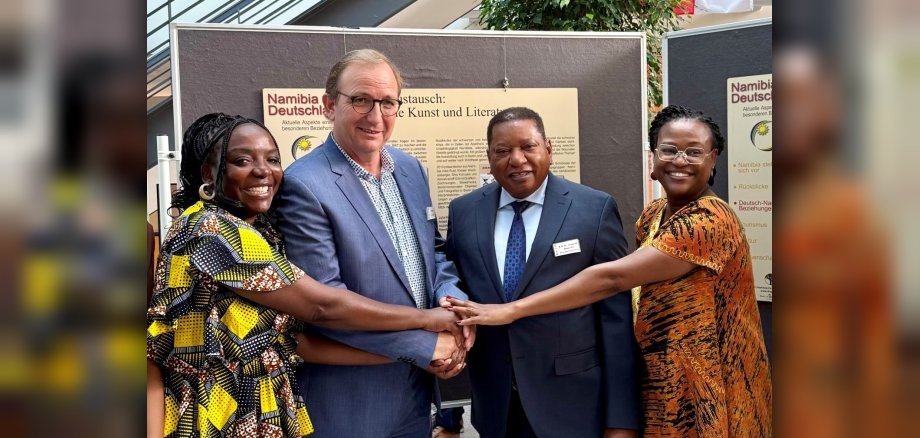
Staßfurt/Eenhana. These links are not merely historical; above all, they have endured over the decades and across thousands of kilometres, particularly on a personal level. Between 1985 and 1990, 400 Namibian children lived in Staßfurt in the Salzlandkreis district. Now, this shared past is to form the basis of a new partnership.
The travelling exhibition “Namibia and Germany: Current Aspects of a Special Relationship”, on display at the Sparkassenschiff on Lehrter Straße in Staßfurt, provides further inspiration in this regard. It can be viewed free of charge in the foyer during opening hours until 16 October. No booking is required. The exhibition is sponsored by the Salzlandkreis, the Salzlandsparkasse and the office of the Namibian Honorary Consul, Burchard Führer.
At the opening ceremony, District Administrator Markus Bauer and the Namibian Ambassador, Jerobeam Shaanika, emphasised their desire to develop the existing links – particularly between the town of Eenhana in the Ohangwena region of northern Namibia and the Salzlandkreis – into a lasting and vibrant partnership. A corresponding resolution by the Salzlandkreis District Council on this matter is already in place. Kadiva Hamutumwa, the regional governor responsible for Ohangwena, also supports the initiative.
District Administrator Markus Bauer said at the official opening: “It is important to look beyond our own horizons. We therefore want to forge links and bring different cultures together. Regular exchanges at various levels enable us to generate new ideas, and both regions can benefit as a result.” The basis for this is the Salzlandkreis 2030 Future Strategy. Ambassador Jerobeam Shaanika also spoke of a win-win situation in his welcoming address at the exhibition opening.
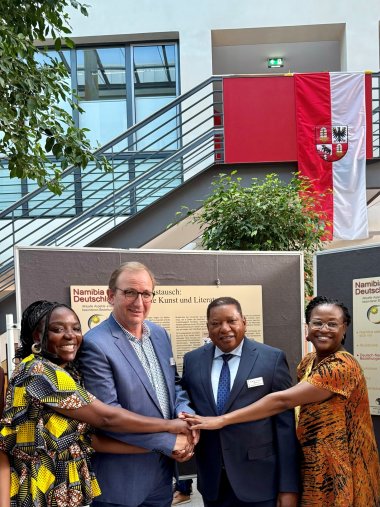
The exhibition at the Sparkassenschiff in Staßfurt, organised by the German-Namibian Society, explores the history of this South-West African country in the context of the German colonial era from 1884 onwards. At that time, Germany initially took control of the territory in south-west Africa as a ‘protectorate’, as it was officially known.
The following decades, however, were marked by extremely bloody clashes between the German colonialists and the local population. Although Germany lost all its territorial claims after the First World War, the country remained, according to the German-Namibian Society, effectively a colony – this time of the neighbouring South Africans.
During the Cold War, the GDR supported the independence movement’s armed struggle for liberation and, in this context, also took in children at risk from refugee camps, including Naita Hishoono, who now heads the Namibia Institute for Democracy. At the exhibition opening, she reflected on her childhood in Staßfurt and also called for a revival of the twinning partnership. “When people come together, when civil society comes together, then we can all achieve more together. Town twinning partnerships have always made a difference throughout history.”
Naita Hishoono returned to her homeland following Namibia’s independence in 1990, when she was 14 years old, and over the past few days has been showing her daughter the places of her childhood. “I grew up here with lots of other children under the care of German teachers and nursery staff. That’s why Germany is just as much my home as Namibia.”
Since the mid-1990s, there has been cooperation between Germany and Namibia in the fields of business, science and culture. Various towns and local authorities from across Germany have also established twinning arrangements with Namibian local authorities. In 2021, as a final step in coming to terms with the past, the then Federal Government acknowledged its historical responsibility and committed itself to making amends.
The Salzlandkreis also wishes to play a part in the existing network between Germany and Namibia, as District Administrator Markus Bauer explained at the exhibition opening. He referred to Anhalt University of Applied Sciences, which could act as a cooperation partner in the field of science, as well as various general education schools in the region, which are in principle suitable as partners for youth exchanges.
Exhibition: ‘Namibia – Germany. Current aspects of a special relationship’
Location:
Opening hours until 16 October: Mondays 8 am to 4 pm, Tuesdays and Thursdays 8 am to 6 pm, Wednesdays and Fridays 8 am to 3 pm
Free admission