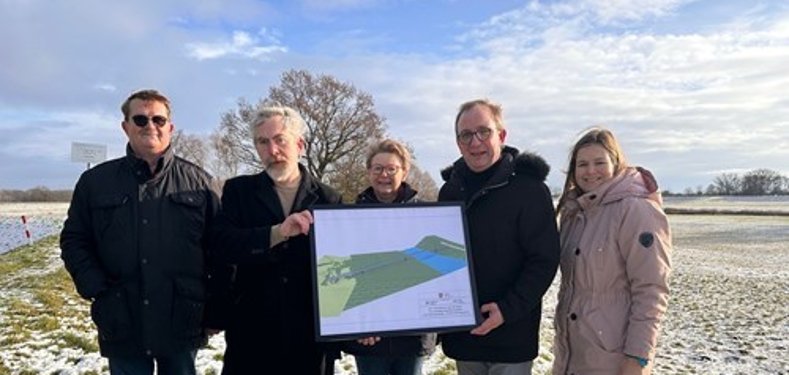
Bernburg/Groß Rosenburg. The letter from Berlin has arrived: the Federal Ministry for Economic Affairs and Climate Protection has approved the Salzlandkreis district's project application and is providing the nearly €4.8 million needed to build the "NKI: Cycle bridge over the Saale and sustainable mobility services in the municipality of Barby/Groß Rosenburg district". District Administrator Markus Bauer emphasises that this is the first project in Saxony-Anhalt to be funded by the National Climate Protection Programme and provides information about the long-awaited funding decision. "We are very pleased and are starting the new year as we have been working towards it according to plan in previous years and months. Our infrastructure expansion continues and, little by little, the various areas and sections are coming together to form a convincing overall picture for our rural residential location as a hinge between Magdeburg and Halle."
In order to effectively improve climate-friendly mobility in the Elbe-Saale-Winkel region, the Salzland district developed its pilot project together with the town of Barby. Barby's mayor, Dr Jörn Weinert, is therefore particularly happy about this great news: "The district is working hard to develop the region and tourism together. I think I speak for many, because the majority of people in the region see this as a gift," he says, thanking the district administrator.
The new cycle and pedestrian bridge over the Saale, which connects the districts of Groß Rosenburg and Tornitz, is due to be built from spring 2026 and completed in 2027, making it relevant for locals and their daily journeys as well as for tourists in the region. The National Climate Initiative project focuses on the issues of sustainable mobility, affordability and accessibility in rural areas, setting a nationwide example for other regions close to rivers. With the realisation of the project in the Elbe-Saale-Winkel, known mobility gaps are finally being reduced with a climate-friendly solution that can be used additionally and universally and also integrates the new dyke systems around Barby. The district administration, the specialised services involved and the district economic enterprise responsible for district roads are working closely with the town of Barby, the State Office for Flood Protection and Water Management and the Magdeburg Federal Waterways and Shipping Office to implement the project.
The project-accompanying working group of the partners involved began its work at the end of 2021. With the support and decision of the district council, the funding application soon followed in 2022, which was subsequently repeatedly coordinated and updated with the funding providers, and the district administration awarded the first planning services to two engineering consortia working in partnership in Magdeburg. The planning office is currently working on the design planning for the bridge, which is the final result of six preliminary planning variants.
The new, four-span steel truss bridge for cyclists and pedestrians - 275 metres long and three metres wide, making it one of the largest cycle bridges in Germany according to the planners - will span the Saale at Groß Rosenburg and connect to the Saale cycle path on both sides, continuously and independently of the existing ferry service offered by the town of Barby. The bridge is supported by two abutments and three reinforced concrete piers, three and a half metres above the top of the embankment. Thanks to its construction method with very little ecological impact, it guarantees maximum safety for cyclists. New bicycle service stations are also to be built at Sachsendorf and Gnadau railway stations, making it easier for commuters in particular to switch to bicycles.
As things stand at present, a total of around 6.3 million euros will be needed for the project. The Salzland district is covering the planning costs from its budget and has already made advance payments. With this project, the district administration is realising goals from the Salzlandkreis 2030 future strategy and its own climate protection concept.
To secure overall funding for its project, the district has received support from the National Climate Protection Programme and the federal "Cycling and Climate Protection" programme. This programme promotes investment-based regional measures with a model character for the climate-friendly and cycle-friendly redesign of road space, the construction of necessary and additional cycling infrastructure and the establishment of local cycling services.
The Salzland district has been successfully promoting cycling for its residential and business location for years. Its cycle path concept for the development of cycling for everyday life, leisure and tourism has been available since 2020. The aim is to develop a standardised district-wide cycling network that integrates and links all locations, closes gaps and thus promotes the use of bicycles. The concept sets out clear priorities and concrete approaches for action, the basis for a gradual conversion and expansion of the district-wide cycle network.
"The residential and business location of the Salzland district as a whole will benefit from this multi-million euro investment in the new cycle bridge in the Elbe-Saale-Winkel region," explains District Administrator Markus Bauer. He says: "We want to develop the region and create identity, incentivise people to live and work here and get involved. Our goal is: a family location."
To achieve this goal, the Salzland district has been pursuing such sustainable projects for some time with its own design options, in terms of infrastructure or public transport. "Our cycle path concept and the expansion of the R1 are part of this to further promote the switch from car to bike. We offer other contemporary mobility options with our new jetty facilities on the Bode and Saale rivers, not least when the Salzland Railway project is realised in the rural area between Magdeburg and Halle."